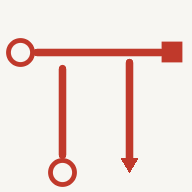
Same Length. But the Filled One is Longer.
Which line/shape is bigger?
You are looking at the Oppel-Kundt illusion, discovered by Johann Oppel in 1855 and re-documented by August Kundt in 1861 · one of the oldest size illusions in the scientific catalogue. Two equal horizontal line segments. One is empty; the other is subdivided by a row of evenly-spaced tick marks or dots. The filled segment looks distinctly longer. The tick marks have added no length · the two segments are measured identical · but your brain insists otherwise.
What you are about to learn. What the illusion actually is, why filled space feels bigger than empty space, the magic tick-count (somewhere between 8 and 12 is optimum), what happens when you vary the spacing, and how the effect transfers to time perception and journey estimation.
What the Illusion Looks Like
Draw a horizontal line segment of a given length, say 200 pixels. To the right, draw another segment of the same length. Now subdivide the first segment by placing, say, ten short vertical tick marks along it, evenly spaced. Compare the two.
The segmented segment is now perceived as longer · often by 10 to 20 percent · even though a ruler will confirm they are identical. Swap the tick count for dots, and the effect persists. Replace the straight line underneath with a transparent span, and the effect persists. What matters is the density of features within the span, not the line underneath.
The minimal recipe. Any equal-length comparison where one span contains internal features and the other does not. The features can be tick marks, dots, subdivisions, colour gradients, even repeating patterns · anything that draws the eye multiple times. The empty span loses because nothing occupies it.
Why Filled Looks Longer
The dominant account is attentional: each feature along a filled line is a separate point where your gaze momentarily anchors. Scanning the line involves more eye movements, more visual processing, more perceptual events. Your brain uses those events as an implicit tally of “how much line did I just cross?”
Your eyes never glide smoothly over a stimulus · they saccade in discrete jumps, resting briefly on salient points. On an empty line, there are no salient points except the two endpoints: two saccades, roughly, to cover the span.
On a tick-filled line, every tick mark is a saccade target. Ten ticks plus two endpoints means roughly twelve fixations to cover the same physical distance.
Your brain uses the count of fixations as a proxy for distance. More fixations = more distance travelled, subjectively. So the line with more internal structure feels longer even though the physical endpoints are the same.
This is a perceptual time-for-distance substitution. Your visual system does not have a native “length in degrees of visual angle” sensor. It estimates length from a bundle of cues: angular extent, number of saccades, integration time, cognitive effort. The Oppel-Kundt exploits the saccade-count cue directly.
The Optimum Tick Count
A natural question: more ticks = more illusion? Up to a point.
In controlled experiments, the Oppel-Kundt effect grows with the number of subdividing features until roughly 8 to 12 ticks, then plateaus, then slightly decreases as the line becomes visually saturated. At very high feature densities (100+ ticks in a short span), the line reads as a blurry grey bar and the discrete-saccade mechanism stops applying · you are no longer counting features, you are seeing a texture.
The practical implication: a moderate density of features produces the strongest illusion. This is also the range where your saccade-counting machinery is most active.
The real-world correlate. Journeys through varied, feature-rich landscapes feel longer than journeys of the same distance through empty landscapes. A 20-minute drive through a city centre feels longer than a 20-minute drive through desert. The same saccade-counting mechanism is at work, now counting scene changes instead of tick marks. Route designers exploit this: a scenic route feels more generous than a highway of the same length.
The Spacing Variable
What if you keep the tick count the same but vary the spacing?
- Evenly spaced ticks: maximum illusion. The line looks uniformly “filled”.
- Ticks clustered at one end, empty at the other: the clustered end gets a local Oppel-Kundt boost, but the overall effect on the whole-segment judgement weakens. Your brain reads the empty section as empty, and the result is mixed.
- Ticks at the endpoints only (so the segment has just two marks plus its two endpoints): almost no illusion. Your brain has nothing extra to count.
Common misconception: “it is the tick marks that are the illusion.” It is not the marks themselves. Replace ticks with tiny photographs, with numbers, with differently-coloured dots, with words · anything that the visual system will treat as “separate things worth fixating on” · and the illusion reappears. The underlying mechanism is the count of attention-capturing features, not the ticks specifically.
Applications Beyond Lines
The Oppel-Kundt generalises to:
- Time perception. A ten-minute span filled with events (a news segment, a song, a conversation) feels longer than a ten-minute span of silence. This is sometimes called the “filled duration illusion” and is genuinely the Oppel-Kundt in the time domain.
- Route planning. Maps with many intermediate waypoints (gas stations, landmarks, town names) feel like longer trips than sparse maps of the same route, regardless of actual distance.
- Book and film pacing. Chapters or scenes with many small incidents feel longer than equally-paced but event-sparse sections. Editors sometimes deliberately thin a section to make it feel tighter.
- User interface design. A progress bar with many small ticks reads as “longer to wait” than an unmarked one, even at the same fill ratio. Designers with patience for their users use unmarked bars; designers who want to make “X of Y steps remaining” salient use ticks.
Design implication: choose your ticks deliberately. If you want a span · in time, on a line, on a map, in a progress bar · to feel generous and substantial, fill it with features. If you want it to feel brisk and compact, leave it plain. This is the Oppel-Kundt translated into a practical tool.
A Harder Variant
Below is an Oppel-Kundt figure at difficulty 3 · fewer ticks, less aggressive. The effect is subtler but still present. The generator keeps the line length constant and only adjusts tick density, so you can directly compare the two versions.
Which line/shape is bigger?
Cover the tick marks with a finger. Hold a fingertip horizontally across the filled segment, hiding the tick marks. Now both segments look the same length. Lift your finger and the filled segment immediately swells. This is the fastest way to prove that the marks · not any hidden property of the line · are driving the illusion.
Test Yourself on 50 More Illusions
The Oppel-Kundt is one of more than 50 classical illusions on PlayMemorize. Each round draws a deterministic SVG scene and asks one grounded question: which is larger, which is brighter, which is actually parallel. The reveal overlay shows the true geometry plus a one-line “why it works” caption.
- Keep playing Oppel-Kundt → · the standalone game, pinned to this one figure with fresh seeds each round
- Play Illusions → · spot the tricks across size, colour, orientation, and impossible figures
- Play Spatial → · train mental rotation and area estimation
- Play Matrix → · abstract pattern reasoning under time pressure
The takeaway. The Oppel-Kundt illusion is the cleanest piece of evidence we have that your brain does not measure distance · it counts events. Every saccade your eye makes, every feature you fixate on, every discrete moment of attention is a tally mark. String those tally marks together and you have an estimate of how much space (or time) you just crossed. It is a beautifully economical heuristic that almost always works. And when it fails, it tells you something about how your perception is constructed.
Illusions
Your eyes lie - the math knows the truth. Spot equal lengths, identical greys, and truly parallel lines across 57 classic optical illusions
العب الآن - مجاناًلا حاجة لحساب. يعمل على أي جهاز.