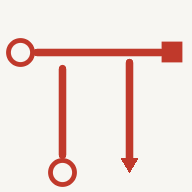
Two Lines. Same Length. You Will Not Believe It.
Which line/shape is bigger?
You are looking at one of the most famous optical illusions in the world: the Muller-Lyer illusion. Two line segments of identical length, one capped with outward-pointing arrowheads and the other with inward-pointing tails. The figure above is generated by the same code that powers the standalone Illusions game, so the equality is real, not a claim. Measure the shafts and they are the same. Close the ruler and they are not.
What you are about to learn. What the illusion is, four competing theories for why it fools you, the fascinating cross-cultural twist (some people are nearly immune), and a trick to shut the illusion off with your own hand.
What the Illusion Looks Like
Two horizontal lines stacked on top of each other. The top line has a pair of inward-facing arrow tails at each end, like this: >---<. The bottom line has outward-facing arrowheads: <--->.
The shaft with arrowheads pointing out looks noticeably longer. On most viewers the effect is in the 20 to 25 percent range · a full quarter of the line’s apparent length.
The minimal setup. You do not need elaborate artwork to reproduce this. Two equal line segments plus four small angle marks at the tips · outward on one, inward on the other · is enough. Franz Muller-Lyer first published the figure in 1889, and it has survived more than a century of attempts to explain it away.
The Lines Really Are Equal
This is the whole point of the illusion. The two shaft lines have identical pixel length, identical endpoint coordinates, identical everything · except the tiny wings at the tips. Your visual system does not compare shaft-to-shaft. It compares the whole figure-to-figure, and that is where it gets tricked.
Four Theories for Why It Works
Researchers have argued about the Muller-Lyer for more than a hundred years. Four explanations keep coming up, and they are not mutually exclusive · the effect is probably a combination of several.
Size constancy (Gregory, 1968). Your brain evolved to see three-dimensional scenes, not flat diagrams. Outward-pointing arrowheads look like the nearby corner of a building jutting toward you. Inward-pointing tails look like the far corner of a room receding away from you. If two objects project the same retinal size but one feels farther away, your brain upscales it to compensate · because in the real world, distant things must be larger than they look. The shaft with the tails (interpreted as “far”) gets stretched.
Conflicting centroids. Your eye does not measure endpoints cleanly. It estimates the midpoint of the whole figure, wings included. Outward arrowheads pull the centroid outward, so the “length” your brain picks up is effectively longer. Inward tails pull it inward. The judgement is about the whole shape, not the shaft.
Eye-movement theory. When your gaze saccades from one end of a shape to the other, it overshoots or undershoots based on what the tips look like. Arrowheads cause the eye to sweep further outward; tails rein it in early. The muscle memory of the sweep becomes the felt length.
Low-level neural filtering. Your visual cortex runs every image through a bank of centre-surround filters. The filters blur the line endpoints together with the wings. Arrowheads fatten the apparent ends of the shaft; tails pinch them. The blurred output is what reaches conscious perception, and it is genuinely longer on one figure.
Quick home test. Print two Muller-Lyer figures on paper. Hold a ruler against each shaft. The illusion does not disappear · you will still “see” a difference even with hard evidence in your hand that the shafts are identical. Perception is not overridden by knowledge. That gap is the whole point.
The Cross-Cultural Twist
Here is where it gets strange. In the 1960s, psychologists Marshall Segall, Donald Campbell and Melville Herskovits compared Muller-Lyer performance across continents. Western urban adults were the most fooled. Rural populations living in round-hutted, non-rectilinear villages (Zulu and San peoples in southern Africa, forest dwellers in Papua New Guinea) showed a much weaker effect · sometimes none at all.
The “carpentered world” hypothesis. If the illusion is driven by your brain interpreting arrowheads as near/far corners, then people who grew up in environments without right angles and corridors have less reason to make that interpretation · and they are less fooled. This is one of the strongest pieces of evidence that visual perception is partly learned, not purely hard-wired.
Common misconception: “just focus harder and it goes away.” No amount of staring, squinting, or “concentrating on the line” makes the Muller-Lyer illusion dissolve. It is baked in below conscious vision. Measuring with a ruler gives you the truth, but re-looking at the figure still shows you a lie. This is a feature of the visual system, not a failure of attention.
How to Unfool Yourself (Sort Of)
You cannot shut the illusion off · but you can reduce it. Try this on the figure below.
Which line/shape is bigger?
Cover the wings with your fingers. Pinch the page (or your phone screen) so that only the two shafts are visible, with the arrowheads and tails blocked. The illusion collapses instantly. Now the shafts look identical, because they are. Release your fingers and the length difference snaps back. This is the cleanest demonstration that the wings are doing all the work.
Stare at a single endpoint. Fixating on one end of the shaft · rather than sweeping your gaze across the whole figure · weakens the eye-movement component of the effect. It will not eliminate the illusion, but it shrinks it by a few percent.
Where You Actually See It
The Muller-Lyer is not just a textbook curiosity. Architects exploit it: interior corners with outward moldings look bigger than they are, and rooms with converging trim look smaller. Typographers use it for tracking: the ends of an italic stroke can read longer or shorter depending on the terminal shape. Fashion designers know the V-neckline effect is partly Muller-Lyer · the outward points of the V visually lengthen the torso. Even arrow keyboard glyphs on a computer (the <, > characters bracketing menu paths) play with the same trick.
Why this matters for your brain-training. Illusions are not tricks. They are a window into the assumptions your visual system is making all the time · assumptions that are normally correct and help you navigate a 3D world, but occasionally get caught out by a clever flat drawing. Training yourself to notice them sharpens the metacognitive skill of “what is my brain filling in that is not actually there?” That skill transfers to reading data visualisations, spotting misleading charts, and debugging your own intuitions.
Test Yourself on 50 More Illusions
The Muller-Lyer is one of more than 50 classical illusions on PlayMemorize. Each round draws a deterministic SVG scene and asks one grounded question: which is longer, which is brighter, which is actually parallel. The reveal overlay shows the true geometry plus a one-line “why it works” caption.
- Keep playing Muller-Lyer → · the standalone game, pinned to this one figure with fresh seeds each round
- Play Illusions → · spot the tricks across size, colour, orientation, and impossible figures
- Play Spatial → · train the mental rotation skill that underlies much of illusion immunity
- Play Matrix → · abstract pattern reasoning under time pressure
The takeaway. The Muller-Lyer illusion is not a flaw in your eyes. It is a symptom of a very well-tuned brain applying three-dimensional reasoning to a two-dimensional drawing. You cannot turn it off. But understanding what it is tells you something real about how perception works · and that is more useful than any “cure”.
Illusions
Your eyes lie - the math knows the truth. Spot equal lengths, identical greys, and truly parallel lines across 57 classic optical illusions
שחקו עכשיו - בחינםללא חשבון. עובד בכל מכשיר.