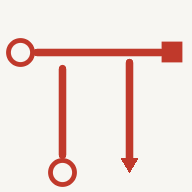
Same Setup as Hering, Inverted. The Lines Bow Inward Now.
Are the lines parallel or slanted?
You are looking at the Wundt illusion, described by the German psychologist Wilhelm Wundt in 1896 · often credited as the founder of modern experimental psychology. The figure is the mirror image of the Hering illusion: instead of radial lines fanning outward from a single central point, a pattern of lines converges toward (or emerges from) the edges toward an invisible central region. Two parallel horizontal lines, one above centre and one below, are overlaid on this converging pattern. The parallel lines appear to bow inward · each curves toward the centre rather than away from it. They are in fact perfectly straight and perfectly parallel.
What you are about to learn. What the Wundt illusion is, why it is the exact inverse of the Hering illusion, how the same V1 orientation-contrast mechanism produces opposite bow directions given different background geometries, what Wundt’s role in experimental psychology was, and why the Wundt-Hering pair is a clean demonstration of the predictive power of the orientation-contrast model.
What the Illusion Looks Like
Draw a pattern of radial lines, but reversed in orientation relative to the Hering figure: instead of all lines emerging from a single central point and radiating outward, have them converge toward a central region from the edges of the page · or draw two converging bundles, one above and one below, that almost but not quite meet at the horizontal midline. Now draw two horizontal parallel lines, one above the midline and one below, across the full width of the page.
The parallel lines do not look straight. The upper line appears to dip downward at its midpoint; the lower line appears to rise upward at its midpoint. The two lines appear to draw closer together in the middle and spread apart at the ends, forming a kind of convex bowtie or bulged-inward shape. Physically, they are parallel. The apparent bow is a Wundt.
The minimal recipe. A background pattern of lines converging inward toward a central region (the opposite of Hering’s radial-outward pattern). Two parallel horizontal lines overlaid on this pattern. Just as with Hering, the effect is strongest when the radial density is 20 to 50 lines and when the parallel lines are oriented horizontally or vertically.
Why It Works: Orientation Contrast, Reversed
The Wundt illusion uses the same cortical machinery as the Hering · V1 orientation-contrast · but with the sign of the inducer orientation reversed at each location.
The background provides a different local orientation field. In the Hering figure, at a point near the middle of the horizontal test line, the nearby radial lines are oriented obliquely, pointing away from the centre. In the Wundt figure, at the same point, the nearby radial lines are oriented obliquely in the opposite direction · pointing inward toward the centre from the edges.
V1 orientation contrast pushes the apparent tilt the opposite way. In Hering, the apparent tilt of the horizontal line is pushed away from the inducer orientation · outward. In Wundt, the inducer orientation is reversed, so the apparent tilt is pushed inward · toward the centre. Same mechanism, opposite inducer, opposite perceived shift.
The integrated bow is inward. Just as the Hering bow was the cumulative integration of outward-pointing apparent tilts along the parallel line’s length, the Wundt bow is the integration of inward-pointing apparent tilts. The perceived curvature has the opposite sign.
Same illusion, rotated 180 degrees. Wundt and Hering are not two separate illusions · they are the two polarities of a single underlying mechanism. By showing that the same V1 orientation-contrast effect predicts opposite perceived bows given opposite inducer orientations, the pair provides strong evidence that the explanation is correct. If the bow direction had not reversed between the two figures, the orientation-contrast account would be in trouble. It does, so the account holds.
Wundt’s Larger Contribution
Wilhelm Wundt founded the first experimental psychology laboratory in Leipzig in 1879 · an event traditionally taken as the start of modern experimental psychology. He contributed to virtually every area of the discipline, from reaction-time measurement to introspection methodology to comparative cultural psychology (Volkerpsychologie).
Wundt and the psychophysical method. Wundt’s laboratory emphasised precise measurement of perceptual variables · reaction times, stimulus thresholds, discrimination limits. The Wundt illusion was one of many demonstrations he used to argue that perception is subject to law-like dependencies that can be measured and modelled. The illusion was a minor part of his overall output, but his approach · treat perception as a quantitative science · shaped the field for the following century.
Try the switch test. Open a Hering and a Wundt figure side by side. Notice that the horizontal parallel lines look the same in both · just straight horizontals · until you attend to the radial pattern. Once the radial pattern registers, the bow direction flips. Your brain’s bow-inference is strictly conditional on the inducer orientation at each point. If you block the inducers with your hand and look only at the parallel lines, both Hering and Wundt illusions collapse to straight parallels.
A Harder Variant
Below is a Wundt figure at difficulty 3 · denser converging lines, stronger inward bow. The parallel lines appear to pinch together visibly at their midpoints.
Are the lines parallel or slanted?
Common misconception: “Wundt is just Hering upside down.” It is not “upside down” in the sense of a mirror reflection of the same image · the two figures are geometrically distinct. The Hering uses radial outward lines; the Wundt uses radial inward lines. The two inducer patterns produce opposite sign V1 orientation-contrast effects at every point along the parallel test lines. They are not mirror images; they are two different stimulus configurations that happen to produce opposite bow directions. The unifying principle is the V1 mechanism, not a geometric symmetry of the images.
Predictions from the Orientation-Contrast Model
The Wundt-Hering pair demonstrates the predictive power of the orientation-contrast account. Several derivative predictions follow:
Testable derivatives. Prediction 1: an inducer pattern of mixed orientations (some radial, some anti-radial) should produce a partial bow or no bow · both effects observed. Prediction 2: moving the inducer lines very close to the parallel test line should increase the illusion, moving them far should decrease it · confirmed psychophysically. Prediction 3: adaptation to one inducer orientation should temporarily boost the apparent shift in the opposite direction · the tilt after-effect. Confirmed in classical psychophysics. The Wundt-Hering pair is the generator of predictions that have been tested and largely confirmed.
Where the Wundt Illusion Appears
- Tunnels and vanishing-point photography. A tunnel or road receding in a photograph creates lines converging toward a central vanishing point. Horizontal cross-elements (cross-hatching, ladder rungs on a tunnel wall, painted lane markers) look bowed inward · a Wundt effect at work. Cinematographers use this deliberately for dramatic perspective shots.
- Opticians’ perimetry tests. Some vision tests use converging-line backgrounds to assess whether a patient’s orientation-contrast processing is symmetric across the visual field. Asymmetric Wundt illusions on the left vs. right can indicate specific V1 or V2 abnormalities.
- Op Art. Op Art painters (Bridget Riley, Victor Vasarely) explored both Hering and Wundt geometries extensively. Riley’s Fall (1963) uses a wave pattern that exploits inward-bow perception. The emotional impact of the painting depends heavily on the Wundt-style inward distortion.
- Typography and logos with converging accents. Radial motifs on logos that converge toward a central word or symbol produce slight Wundt distortions on any horizontal or vertical elements near the centre. Designers often adjust alignments to compensate.
- Stage set design. Theatre sets with converging lines drawn on the back wall or floor create Wundt-style distortions for the audience · used for dramatic effect in perspective-heavy productions.
Test Yourself on 50 More Illusions
The Wundt illusion is one of more than 50 classical illusions on PlayMemorize. Each round draws a deterministic SVG scene and asks one grounded question: which is larger, which is brighter, which is actually parallel. The reveal overlay shows the true geometry plus a one-line “why it works” caption.
- Keep playing Wundt → · the standalone game, pinned to this one figure with fresh seeds each round
- Play Illusions → · spot the tricks across size, colour, orientation, and impossible figures
- Play Spatial → · train mental rotation and area estimation
- Play Matrix → · abstract pattern reasoning under time pressure
The takeaway. The Wundt illusion is the mirror image of the Hering in orientation-contrast space. Given a background of converging-inward radial lines, parallel test lines appear to bow toward the centre · the exact opposite of the Hering outward bow. The unifying mechanism is V1 orientation contrast: nearby edge orientations mutually inhibit, and the perceived direction of the test line shifts away from the inducer orientations. Wundt’s stimulus is a clean demonstration that the V1 account correctly predicts bow-direction reversal under inducer inversion. His legacy is much broader · he founded experimental psychology · but the Wundt illusion endures as one of his most portable contributions.
Illusions
Your eyes lie - the math knows the truth. Spot equal lengths, identical greys, and truly parallel lines across 57 classic optical illusions
अभी खेलें - यह मुफ़्त हैकिसी खाते की ज़रूरत नहीं। किसी भी डिवाइस पर काम करता है।