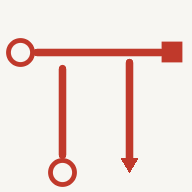
Two Diagonals. One Parallelogram. The Long One is Short.
Which line/shape is bigger?
You are looking at the Sander parallelogram illusion, named for the German psychologist Friedrich Sander, who published it in 1926. A parallelogram is divided by two diagonals · one runs from the longer pair of vertices, the other from the shorter pair. The diagonal that sits in the “wide” half of the parallelogram looks dramatically longer than the one in the “narrow” half. Measure them on screen and they are identical. The figure above is drawn by the same deterministic generator that powers the standalone Illusions game.
What you are about to learn. What the Sander illusion actually is, why it is one of the strongest size illusions ever documented (effect sizes of 25% are routine), the three theories that compete to explain it, and why flat observers see it much more strongly than people with practised 3D-reasoning skills.
What the Illusion Looks Like
Draw a parallelogram · a rectangle tilted over so one side drags forward. Divide it with two diagonals: one goes from the left-forward corner to the top-back corner (the “short” diagonal in a rectangle, but now running through the wider half of the skewed figure); the other goes from the left-back corner to the top-forward corner (crossing the narrower half).
The diagonal through the wide half looks significantly longer. It is the same length as the other.
Effect size matters. The Sander is not a subtle illusion · unlike Müller-Lyer or Ebbinghaus, where the effect is a solid but modest 15 to 20 percent, the Sander routinely produces 25-percent effects in naïve observers. It is one of the most robust size illusions ever reported, partly because the depth cue is delivered in a single, unmissable geometric gesture.
Three Theories
Size-constancy scaling (Gregory-style). The parallelogram is read as a 3D object · a rectangle tilted away in depth. Once the brain commits to that reading, the diagonal that crosses the “wider” (apparently farther) half is scaled up, just as the top bar in the Ponzo is scaled up for sitting at the vanishing end of the rails. Size-constancy machinery at work.
Whole-shape centroid bias. Your brain implicitly measures the diagonals relative to the whole figure. The wide half of the parallelogram occupies more area, so a diagonal crossing it inherits a longer “apparent sweep”. The narrow half, carrying less area, pulls its diagonal toward feeling shorter. This is the same conflicting-centroid account proposed for Müller-Lyer.
Local angle-distortion. At the obtuse corners of the parallelogram, the diagonals meet the parallelogram’s sides at small angles; at the acute corners, they meet at large angles. Research on angle perception shows that acute angles tend to be overestimated · which would make the diagonal that terminates in the acute corners “feel longer” than the one in the obtuse corners. This is the classical Müller-Lyer-style centroid mechanism applied to angle geometry.
All three theories predict the same direction of error. That is why the Sander is so robust · regardless of which mechanism is doing the work, they all agree on the answer. Isolating which mechanism dominates experimentally requires unusual stimulus designs (for example, removing the parallelogram and leaving only the two diagonals, which kills the effect entirely).
Why It is Stronger than Müller-Lyer
In direct side-by-side studies comparing effect magnitudes, the Sander parallelogram typically beats Müller-Lyer by 5 to 10 percentage points. The working explanation: Müller-Lyer delivers one depth cue (the fins suggesting near/far corners). The Sander delivers two · the parallelogram outline is a depth cue and the diagonal-vs-acute-corner geometry is a second, independent one. They stack.
Illusions stack when they agree. A rough rule of thumb in visual psychophysics: when two independent illusion mechanisms point in the same direction, the combined effect is larger than either one alone, often by the sum of their individual magnitudes. When they point in opposite directions, they partially cancel. The Sander is a textbook example of stacking.
The 3D-Reasoning Modulation
An interesting modulation comes from studies comparing Sander performance in people with strong three-dimensional-reasoning skills (engineers, architects, video-game players trained on perspective interpretation) versus those without.
Contrary to naïve expectation, the groups with practised 3D-reasoning skills show slightly stronger Sander effects, not weaker ones. The theory: they apply depth-scaling more aggressively and more confidently, so the parallelogram-as-tilted-rectangle reading is faster and more insistent, and the diagonals get scaled more forcefully.
Common misconception: “experts are immune to illusions.” For illusions driven by perceptual expertise (face inversion, Thatcher illusion, chess-piece recognition), experts are often less fooled. But for illusions driven by automatic depth-scaling mechanisms (Müller-Lyer, Ponzo, Sander), experts can be more fooled, because they apply the underlying inference more rapidly. Knowing about an illusion does not always mean seeing less of it.
A Harder Variant
Below is a Sander figure at difficulty 3, with a sharper skew. The depth reading becomes more aggressive, and the diagonal-length discrepancy grows correspondingly. The two diagonals are still equal · the mathematics of the parallelogram guarantees it · but the effect is even harder to shake.
Which line/shape is bigger?
Trace both diagonals with your fingertip. Starting from the same corner, run your finger along one diagonal, then trace the other. The physical act of tracing engages the dorsal (action) stream, which is not fooled by the Sander, so your finger does the same travel distance for both. Your conscious “wow, that one is longer” persists even as your hand demonstrates otherwise. This is another case of the two-streams-of-vision dissociation (see also Ebbinghaus and Aglioti 1995).
Where the Sander Hides in Plain Sight
- Graphic design and logos. Logos that use an angled parallelogram frame (think sports-team emblems, travel-company marks) routinely have diagonals whose apparent length differs from their measured length. Designers either lean into the effect (making a word inside the parallelogram feel more dramatic) or compensate by nudging the actual letter widths to equalise perception.
- Architecture. Trapezoidal windows and angled corridor features inherit Sander-style diagonal distortions. A skylight with internal supports can appear far longer or shorter than it is, depending on the parallelogram orientation.
- Data visualisation. Slanted bar charts (popular in the 1980s but rightly out of favour today) fall prey to the Sander: the perceived length of each bar is biased by the slant of the overall chart. Flat, horizontal bars are more honest.
- Tiling and flooring patterns. A parquet floor with long-grain planks at an angle to a room wall will feel different lengths depending on where the plank sits · the long-grain-adjacent-to-wall planks look shorter than their twins sitting in the interior.
Test Yourself on 50 More Illusions
The Sander is one of more than 50 classical illusions on PlayMemorize. Each round draws a deterministic SVG scene and asks one grounded question: which is larger, which is brighter, which is actually parallel. The reveal overlay shows the true geometry plus a one-line “why it works” caption.
- Keep playing Sander → · the standalone game, pinned to this one figure with fresh seeds each round
- Play Illusions → · spot the tricks across size, colour, orientation, and impossible figures
- Play Spatial → · train mental rotation and area estimation
- Play Matrix → · abstract pattern reasoning under time pressure
Why this matters for your brain-training. The Sander illusion sits at the intersection of three separate mechanisms · depth-scaling, centroid bias, and angle-overestimation · all agreeing on the same wrong answer. It is the cleanest single demonstration that your perceptual system is not a measurement device but an inference engine. Studying it is studying one of the deepest inference systems in your brain, and noticing when that inference has been weaponised (by a chart, an advert, a magician) is a transferable skill.
The takeaway. The Sander parallelogram is the size-illusion equivalent of a convicted criminal: three separate witnesses, three different crimes, but all pointing at the same result. You will never talk your conscious vision out of seeing the wide-half diagonal as longer · the mechanism is too layered for knowledge to cut through. But you can measure. And the gap between what you measure and what you see is, itself, the point of every illusion on this site.
Illusions
Your eyes lie - the math knows the truth. Spot equal lengths, identical greys, and truly parallel lines across 57 classic optical illusions
Zagraj teraz - za darmoBez konta. Działa na każdym urządzeniu.