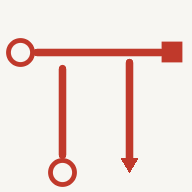
Two Bars Between Rails. Same Length. One Looks Longer.
Which line/shape is bigger?
You are looking at the Ponzo illusion, named for the Italian psychologist Mario Ponzo, who first published it in 1911. Two horizontal bars sit inside a pair of converging lines · railway tracks receding into the distance, a corridor, a road stretching to the horizon. The top bar looks longer. Measure them on screen and they are identical. The figure above is drawn by the same deterministic generator that powers the standalone Illusions game, so the equality is real, not a polite claim.
What you are about to learn. What the Ponzo illusion actually is, why depth cues on a flat figure make two equal bars look different, the famous “Moon illusion” connection, what happens when you swap the rails for arbitrary shapes, and why the effect gets stronger in photographs than in line drawings.
What the Illusion Looks Like
Draw two lines that converge toward a single vanishing point · imagine the two rails of a train track stretching to the horizon. Now place two identical horizontal bars across the rails: one near the bottom, where the rails are far apart, and one near the top, where the rails are close together.
The top bar looks dramatically longer than the bottom bar. In classical Ponzo figures the perceived difference can reach 10 to 20 percent · big enough that asking a naïve viewer to say which is longer almost always yields the “top one”.
The minimal recipe. Any two lines that converge will do: you do not need literal train tracks. A pair of diagonal lines forming a V, a photograph of a corridor, a roadway receding into the distance · all produce the illusion. What matters is that the context carries unambiguous depth cues that push one bar into “far” and the other into “near”.
Why Your Brain Does This to You
The dominant explanation is the size-constancy scaling theory, articulated most forcefully by Richard Gregory in the 1960s.
Your visual system treats converging lines as a depth cue. The narrower they get, the further away they must be. This is a learned perceptual rule, and it is correct almost all of the time in the real world.
Given two objects that project the same retinal size, your brain assumes the “farther” one must be physically larger · because in the real world, distant objects shrink on the retina. To undo that shrinkage, the brain upscales the perceived size of any object it judges to be far away.
The top bar sits where the rails are close together (far away, according to the depth cue). The bottom bar sits where the rails are far apart (near). Same retinal length. Your brain scales the “far” bar up · so it consciously reads as longer.
The clever part. This scaling is automatic, rapid, and pre-conscious. You cannot disengage it by wanting to. Even after measuring both bars with a ruler, looking back at the figure still shows you a longer top bar. The rule is wired below the level where effort helps.
The Moon Illusion Connection
One of the oldest puzzles in visual science · the Moon looks much larger at the horizon than overhead · has a strong Ponzo flavour.
When the Moon is high in the sky, you see it against a blank dark field. When it is near the horizon, you see it against buildings, trees, hills, and distant terrain · context that your brain reads as far. Applying the same size-constancy scaling as in the Ponzo figure, the horizon Moon gets upscaled; the high Moon does not. The retinal image is identical (you can verify this with a pinhole on cardboard), but the conscious percept differs by a factor of 1.5× or more.
Try this tonight. When the Moon looks comically huge at the horizon, bend down and look at it between your legs, upside down. The familiar depth cues are scrambled by the inverted view. The Moon will snap back to its “normal” small size. Stand upright again and the illusion returns.
Does the Rail Shape Matter?
Ponzo himself tried many variants. Two straight converging lines work. So do:
- Two diagonal lines not joined at a vertex · the illusion persists as long as they converge.
- A pair of parallel lines overlaid on a photograph of a receding corridor · now the depth cue is pictorial rather than linear.
- Even two simple angled brackets () around the bars · a weak but measurable effect.
Common misconception: “Ponzo needs literal railway tracks.” No. Any configuration that triggers a depth interpretation · converging lines, overlapping objects, texture gradients, aerial perspective · biases size judgements. The railway-track version is just the cleanest laboratory stimulus, not the cause.
The Photograph Effect
If you place two matchsticks on a photograph of train tracks · one near the horizon, one near the camera · the illusion is roughly twice as strong as the line-drawing Ponzo.
Why? Line drawings carry only the single depth cue of convergence. Photographs carry many: linear perspective, texture gradients (the ties get finer further away), aerial perspective (distant things are bluer and less contrasted), familiar size (a house near the horizon gives absolute scale), and sometimes shadows that imply distance. Every extra cue your brain can parse feeds the constancy-scaling machinery.
The research implication. Perception studies that use photographs as Ponzo stimuli get bigger effect sizes and more reliable responses than those using bare line drawings. If you are designing an experiment and want a strong illusion, use pictorial depth. If you are studying the cue-isolation question, use lines.
Try a Harder Variant
Below is a Ponzo figure at difficulty 3, with steeper rails and a larger size contrast. Watch how much more confidently your brain reports the top bar as longer · the steeper the implied depth gradient, the stronger the scaling.
Which line/shape is bigger?
Cover the rails with your fingers. Block the two converging lines so only the horizontal bars are visible. They snap to the same length, instantly. Lift your fingers and the top bar swells again. This is the cleanest possible demonstration that the depth context · not the bars themselves · is doing all the work.
The Cross-Cultural Angle
The classical cross-cultural Ponzo studies of the 1960s (alongside those on Müller-Lyer) tested subjects from “non-carpentered” environments · rural African and Papuan communities without right-angled architecture and receding corridors. Their Ponzo effects were substantially smaller than those of Western urban viewers.
What that tells us. The Ponzo is partially a learned bias. People who grow up surrounded by built environments with strong linear perspective · streets, railways, corridors · internalise convergence as a depth cue more aggressively, and so their visual systems apply scaling more aggressively when fooled by a flat drawing. The wiring is mostly innate; the strength is modulated by experience.
Where the Ponzo Hides in Plain Sight
- Wide-angle photography. Shooting a subject at the far end of a converging hallway dramatically exaggerates apparent size. Advertising and film use this for comic effect (tall hero, short sidekick).
- Roadside billboards. Letters on a receding billboard are sized to appear uniform, which means the far characters are physically much larger. Designers rely on the constancy-scaling machinery to rescale them back to uniformity.
- Sports and hitting targets. Golfers putting from a distance show a mild Ponzo: a hole sitting at the far end of a green with visible contour lines looks subtly bigger than the same hole on a flat lawn.
- Art and painting. Every Renaissance painter working with single-point perspective is exploiting Ponzo. Once you know to look, you see it in every cathedral painting, every street scene by Canaletto, every marble corridor in Velázquez.
Test Yourself on 50 More Illusions
The Ponzo is one of more than 50 classical illusions on PlayMemorize. Each round draws a deterministic SVG scene and asks one grounded question: which is larger, which is brighter, which is actually parallel. The reveal overlay shows the true geometry plus a one-line “why it works” caption.
- Keep playing Ponzo → · the standalone game, pinned to this one figure with fresh seeds each round
- Play Illusions → · spot the tricks across size, colour, orientation, and impossible figures
- Play Spatial → · train mental rotation and depth estimation
- Play Matrix → · abstract pattern reasoning under time pressure
The takeaway. The Ponzo illusion is not a bug. It is your visual system doing exactly what it should · assuming the world is three-dimensional and correcting retinal sizes for distance. That same correction is what lets you recognise a friend across a crowded room as the same physical size as when they stood next to you. Flat drawings just happen to trick it. Understanding the Ponzo is understanding why your perception is a construction, not a photograph.
Illusions
Your eyes lie - the math knows the truth. Spot equal lengths, identical greys, and truly parallel lines across 57 classic optical illusions
Joacă acum - e gratisFără cont. Funcționează pe orice dispozitiv.