Two Lines. Four Squares. The Line Between the Big Ones is Shorter.
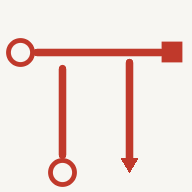
Which line/shape is bigger?
You are looking at the Baldwin illusion, first described by James Mark Baldwin in 1895. Two horizontal line segments. One is flanked at each end by large filled squares; the other is flanked at each end by small filled squares. The line between the large squares looks distinctly shorter than the line between the small squares · but the two lines are exactly the same length.
What you are about to learn. What the illusion actually is, why it is a close cousin of Müller-Lyer but with a cleaner mechanism, the centroid-assimilation theory that best explains it, what happens as you vary the flanker size, and why Baldwin sits near the historical headwaters of the modern size-illusion catalogue.
What the Illusion Looks Like
Draw a horizontal line segment of a given length · say 150 pixels. At each end of the line, draw a large filled square · perhaps 50 pixels on a side · centred on the line’s endpoint. Draw a second line, identical in length, but with much smaller squares at each end · perhaps 10 pixels a side.
The line with the big flanking squares reads as shorter. The line with the small flanking squares reads as longer. The actual line lengths are identical. The magnitude of the Baldwin effect runs typically 5 to 10 percent · comparable to Müller-Lyer.
The minimal recipe. A target line with a shape flanking each end. The shape must have enough visual weight to pull the perceptual measurement. Squares work classically; filled circles, dots, and even letters all produce the effect. What matters is the visual weight of the flanker relative to the line.
Why It Works: Centroid Assimilation
The dominant account is the centroid shift.
Your visual system does not measure lines by their endpoints alone · it measures from the centroid (centre of mass) of one visual feature to the centroid of the other. When the flankers are small, their centroids sit essentially on the line’s endpoints, and the perceived length equals the actual length.
When the flankers are large, their centroids sit inside the square, away from the square’s edge. The perceived length is measured from one centroid to the other, which is shorter than the endpoint-to-endpoint distance, because both centroids sit inside the line by roughly half the flanker’s radius.
The line with large flankers therefore reads as the distance between centroids · not the distance between line endpoints. That distance is shorter. Hence the illusion.
This is the same centroid mechanism as Müller-Lyer. In Müller-Lyer, the fins shift the endpoint-centroid inward (arrows-in configuration) or outward (arrows-out). In Baldwin, the flanking squares shift the endpoint-centroid inward by an amount proportional to the square’s size. Both are centroid-measurement errors, and both produce the same direction of effect in the same family of cases. Baldwin is sometimes called “the cleanest Müller-Lyer” because the fins are replaced with symmetric, geometrically simpler shapes.
The Size-Gradient Experiment
Baldwin’s original 1895 paper included the size-gradient control: what happens as the flanker size grows continuously from very small to very large?
- Tiny flankers (dots): no effect. Centroid sits at the endpoint.
- Small flankers (10 percent of line length): mild shortening effect.
- Medium flankers (30 percent of line length): strong effect, around 7 to 10 percent shortening.
- Large flankers (50 percent of line length or more): effect plateaus and can decrease · the figure now reads as “two squares separated by a small line”, and the centroid machinery disengages.
The ratio, not the absolute size, is what counts. The Baldwin effect depends on the ratio of flanker size to line length. A 20-pixel square flanking a 200-pixel line has the same centroid-shift fraction as a 10-pixel square flanking a 100-pixel line. Scale the whole figure up or down and the illusion magnitude stays constant. This is true of most size illusions · they are defined in proportional, not absolute, units.
Baldwin vs. Müller-Lyer: A Clean Comparison
The two illusions share a family tree. Which is a cleaner demonstration of centroid assimilation?
Baldwin wins on isolation. Müller-Lyer’s fins carry extra information beyond centroid shift · they also cue depth (outgoing fins as a corner pointing away, incoming fins as a corner pointing toward). Baldwin’s flanking squares are orientation-neutral · they offer no depth cue whatsoever. So the Baldwin effect is “pure centroid”, while Müller-Lyer is “centroid plus depth”. This is why Baldwin has been a favourite of researchers testing centroid theory specifically.
Common misconception: “Baldwin is just a weaker Müller-Lyer.” Not quite. The effect sizes are similar, but Baldwin isolates the centroid mechanism while Müller-Lyer confounds it with depth. If you want to test whether centroid shift is real, Baldwin is the experiment · because removing the depth cue does not eliminate the illusion, the centroid mechanism must be doing real work. Several influential papers in the 1990s (Morgan, Hole, and colleagues) used the Baldwin specifically for this reason.
The Historical Moment
Baldwin published this figure in 1895, in the thick of the first great wave of scientific illusion research. In the two decades between 1880 and 1900, dozens of figures were discovered and catalogued · Müller-Lyer (1889), Ebbinghaus (1890s), Zöllner (1860, catalogued widely later), Poggendorff (1860, similar re-catalogue), Delboeuf (1865), Jastrow (1889), and Baldwin’s own.
Why so many in so few decades. The late 19th century was the golden age of psychophysics · the founding of Wundt’s laboratory in Leipzig (1879) had legitimised controlled perceptual experimentation, and the field was hungry for demonstrable phenomena. Simple geometric figures that reliably produced misperceptions were irresistible study targets. By 1900, most of the illusions that still populate textbooks today had been identified.
A Harder Variant
Below is a Baldwin figure at difficulty 3, with a sharper flanker-to-line ratio. The two target lines are still identical.
Which line/shape is bigger?
Cover the flankers. Hold two fingertips over the big flanking squares, so only the line between them is visible. Now look at both central lines · they are clearly the same length. Lift your fingers and the line between the big squares contracts again. Classic centroid-shift: the flankers were doing all the work.
Where Baldwin Appears in Design
- Typography. The visual width of a word depends on the width of the letters flanking it. A word like “MINIMUM” (with wide letters at each end) reads as shorter than a word like “INDULGE” (with narrower letters at each end) of the same typeset width. Designers correct this with optical kerning.
- Punctuation and brackets. Heavy brackets [like this] pull inward on their contents; thin brackets |like this| let the centroid stay out at the endpoint. Typographers have been silently using the Baldwin for centuries.
- Progress bars and sliders. A slider with big circular thumbs at its ends reads as a shorter travel distance than the same slider with small thumbs. Designers routinely size slider thumbs to match the visual weight of the remainder of the UI, partly to manage this illusion.
- Chart design. A bar chart with heavy labels at either end (tick marks, axis numbers) compresses the perceived bar length. Clean axis design with minimal decoration preserves the intended magnitude.
Test Yourself on 50 More Illusions
The Baldwin illusion is one of more than 50 classical illusions on PlayMemorize. Each round draws a deterministic SVG scene and asks one grounded question: which is larger, which is brighter, which is actually parallel. The reveal overlay shows the true geometry plus a one-line “why it works” caption.
- Keep playing Baldwin → · the standalone game, pinned to this one figure with fresh seeds each round
- Play Illusions → · spot the tricks across size, colour, orientation, and impossible figures
- Play Spatial → · train mental rotation and area estimation
- Play Matrix → · abstract pattern reasoning under time pressure
The takeaway. Baldwin’s illusion is a crisp and uncluttered demonstration of centroid-based length perception. Your visual system measures from weighted centres of mass, not from geometric endpoints, and when flanking shapes carry enough visual weight to shift those centres inward, the line between them contracts. Seeing Baldwin is seeing centroid theory in a single glance · and understanding centroid theory is most of the way to understanding the oldest size illusions in the scientific catalogue.
Illusions
Your eyes lie - the math knows the truth. Spot equal lengths, identical greys, and truly parallel lines across 57 classic optical illusions
Играть сейчас - бесплатноБез регистрации. Работает на любом устройстве.