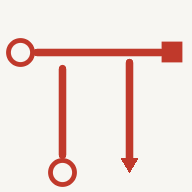
A Line Passes Behind a Bar. It Comes Out Wrong.
Which endpoint continues the line?
You are looking at the Poggendorff illusion, named for the German physicist and editor Johann Christian Poggendorff, who described it in a letter published in Annalen der Physik in 1860 (the journal he himself edited). A single straight diagonal line is drawn across the page. A thick rectangular bar, oriented vertically, crosses the line near its middle. The diagonal line appears to enter the bar on one side and emerge on the other · but its apparent exit point is shifted, usually vertically, relative to where it should come out by pure Euclidean geometry. The line looks broken across the bar. Run a ruler across both visible segments. They are in fact perfectly collinear. The offset is entirely in your perception.
What you are about to learn. What the Poggendorff illusion is, why the diagonal looks discontinuous across an occluder, the two main theoretical accounts (acute-angle expansion and depth-cue reinterpretation), how the illusion’s strength depends on the angle of the crossing line and the width of the bar, and why the Poggendorff is one of the hardest visual illusions to resist even with conscious effort.
What the Illusion Looks Like
Draw a single straight line across the page, tilted at about 30 degrees to the horizontal. Now draw a thick vertical bar (say one-sixth the page width) across the middle of the line. The diagonal line is visible on the left of the bar and on the right of the bar · but not where it passes behind the bar.
You now perceive: the segment on the right appears to be vertically shifted relative to the segment on the left · as if the line were not truly continuous, but rather two separate pieces that happen to emerge from the bar at slightly different heights. Mentally extend the left segment across the bar; you will end up at a different spot than where the right segment actually emerges.
The minimal recipe. A single straight line passing behind (or through) a rectangular occluder. The bar’s orientation should be either vertical or horizontal; the line’s orientation should be oblique, ideally at 20 to 45 degrees to the bar. Too shallow an angle (line almost parallel to bar) or too steep (line almost perpendicular) gives a weak illusion. The bar’s width matters too · wider bars give stronger illusions. The Poggendorff works best at moderate angles and moderate bar widths, which is why the classical demonstration uses those parameters.
Why It Works: Acute-Angle Expansion
The dominant theoretical account of the Poggendorff illusion is based on acute-angle expansion in V1.
Near the bar edges, acute angles are misperceived. Where the diagonal line meets the bar’s edge, two acute angles are formed (the angle between the line and the bar). These acute angles are systematically perceived as slightly larger than they really are · a well-established finding from angle-perception experiments.
Expanded angles shift the apparent line orientation. If the acute angles are expanded, the diagonal line must appear to leave the bar at a slightly shallower slope than it actually does. On the left side of the bar, this apparent-slope shift is in one direction; on the right side, the opposite direction. The net effect: the two line segments appear to lie on different trajectories across the bar.
Your cortex fills in the occluded section consistently with the misperceived angles. When your visual system extrapolates the left segment across the bar to predict where it should emerge, it uses the misperceived angle and lands at the wrong spot. The right segment’s actual emergence point no longer matches, and the line appears broken.
Angle expansion is a V1 phenomenon. The Poggendorff illusion is a consequence of the same V1 lateral-inhibition mechanism that produces the Zoellner and the tilt after-effect · orientation selectivity with mutual inhibition between nearby orientations. Perceived acute angles are expanded because the two nearly-orthogonal orientations (line and bar) push apart in the V1 population code. The Poggendorff is an indirect-but-inescapable consequence of that expansion.
The Competing Account: Depth Cues
A rival explanation proposes that the Poggendorff illusion reflects your visual system’s tendency to interpret the scene as 3D · treating the occluding bar as a foreground object and the diagonal line as lying on a background plane at some angle. Under this interpretation, the line’s apparent trajectory is adjusted to fit the 3D scene, and the apparent offset reflects a 3D-projection correction.
The two accounts are not entirely exclusive. Most contemporary vision scientists believe both mechanisms contribute · the acute-angle expansion story explains the detailed quantitative dependence of the illusion on line angle and bar width, while the depth-cue story explains why the illusion is robust across very different scenes (line through a box, line through a 3D pillar, line across a painted occluder). The Poggendorff is probably a joint product of local V1 processing and higher-level scene interpretation.
Resistance Is Futile
Knowing the line is straight does not help. You can put a ruler on the figure, confirm the collinearity, look back at the bare figure, and the apparent offset is still there.
Common misconception: “concentrating harder will straighten the line.” It will not. Like most cortical-level illusions, the Poggendorff effect is built before your conscious awareness gets a chance to correct it. You can override your verbal description of the scene (“yes, the line is straight”) but not the perceptual impression (“but it looks broken”). The perception comes from V1 and V2 computations that your conscious attention cannot directly modify. This is true of virtually all the classical geometric illusions.
A Harder Variant
Below is a Poggendorff figure at difficulty 3 · with a thicker occluder and a more obliquely angled line. The apparent offset is large and impossible to ignore.
Which endpoint continues the line?
Rotate the figure. If you rotate the whole figure by 45 degrees · so the occluder is now oblique and the line is near-vertical or near-horizontal · the illusion often gets weaker. The Poggendorff is strongest when the occluder is axis-aligned (vertical or horizontal) and the line is at an oblique angle. This is the classic “oblique effect” at work: your cortex processes cardinal orientations (vertical, horizontal) more precisely than oblique ones, and the illusion depends on the asymmetry between axis-aligned and oblique elements.
The Wider-Bar Effect
The width of the occluding bar is one of the strongest modulators of the illusion’s strength.
Wider bar, bigger illusion. A thin bar (1 to 2 percent of the line length) produces only a faint Poggendorff effect. A moderate bar (10 to 20 percent) produces the classical strong version. A wide bar (30 to 40 percent) produces an enormous, uncomfortable-looking offset. This is because the illusion is proportional to the distance your cortex has to extrapolate across the occlusion. More distance, more accumulated misalignment. This dose-response relationship is a key piece of evidence for the acute-angle expansion account · more bar to traverse means more apparent shift.
Poggendorff in the Wild
- Architectural drawings. Structural elements crossing behind columns or through walls in technical drawings can exhibit Poggendorff-like apparent offsets. Skilled drafters know to compensate when drawing for visual clarity.
- Plumbing and electrical diagrams. Pipe or cable runs passing behind obstructions sometimes look discontinuous in schematic diagrams · this is a genuine Poggendorff effect the reader must consciously correct.
- Cable routes in photographs. A fence wire or power line passing behind a building in a photograph often looks kinked. Photographers and painters sometimes exaggerate the actual kink to match the perceived one, which makes the image look “right” to the viewer’s visual system.
- Pool and snooker trajectory estimation. Players judging the path of a ball behind an obstruction make systematic Poggendorff-style errors. Top-level players learn to compensate by mental correction.
- Ship and aviation navigation plots. Bearing lines crossing behind chart symbols on navigation charts can produce Poggendorff shifts. This is one reason modern digital charts render bearing lines as continuous thin lines on top of all other chart elements.
Test Yourself on 50 More Illusions
The Poggendorff illusion is one of more than 50 classical illusions on PlayMemorize. Each round draws a deterministic SVG scene and asks one grounded question: which is larger, which is brighter, which is actually parallel. The reveal overlay shows the true geometry plus a one-line “why it works” caption.
- Keep playing Poggendorff → · the standalone game, pinned to this one figure with fresh seeds each round
- Play Illusions → · spot the tricks across size, colour, orientation, and impossible figures
- Play Spatial → · train mental rotation and area estimation
- Play Matrix → · abstract pattern reasoning under time pressure
The takeaway. The Poggendorff illusion is a reminder that your visual system extrapolates across occlusions, and makes systematic errors when it does. A line that passes behind a bar is not simply “remembered” · your cortex projects the line’s trajectory across the occluded region using a misleading estimate of the line’s angle, and the emergence point ends up displaced. It is the oldest illusion still in active use in vision research, still producing new data, still admitting competing theoretical accounts. Poggendorff the physicist thought he had found a curiosity. He had found a fundamental fact about how your brain reasons through occlusion.
Illusions
Your eyes lie - the math knows the truth. Spot equal lengths, identical greys, and truly parallel lines across 57 classic optical illusions
Şimdi oyna - ücretsizHesap gerekmez. Her cihazda çalışır.