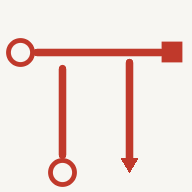
The Vertical Wins. Every Time.
Which line/shape is bigger?
You are looking at the Vertical-Horizontal illusion, one of the simplest and strangest illusions in the catalogue. An inverted T · two line segments of identical length, one horizontal, one vertical · and the vertical one looks longer. Every time. On every viewer. The effect is not large (5 to 10 percent), but it is unusually consistent: across ages, cultures, and individual visual systems, the vertical segment wins.
What you are about to learn. What the illusion actually is, why the inverted-T geometry is especially potent, three theories for why vertical beats horizontal, the asymmetry of the visual field that may be to blame, and why a hat that is as tall as it is wide looks taller to its wearer.
What the Illusion Looks Like
Draw an inverted T: a horizontal line segment sitting on top of a vertical segment that meets it at its midpoint. Make both segments exactly the same length. The vertical segment will look distinctly taller than the horizontal is wide.
There is a weaker version using a plain L-shape or plus-sign, but the inverted T is the cleanest demonstration · partly because the horizontal sits at the top, capping the vertical’s endpoint, which adds a bisection cue (see below).
The minimal recipe. Two equal-length segments that meet at right angles. One must be vertical. The vertical will always read as longer. The effect appears with free-floating segments as well, but it is much stronger when one segment terminates into the other (the T or the L).
Three Theories
Anisotropic visual field. Your visual field is not circular · it is wider than it is tall, with an elliptical shape flattened horizontally. A vertical line therefore occupies a proportionally larger fraction of the field than a horizontal line of the same length. Your brain normalises by your visual field’s dimensions, so the vertical line comes out feeling longer.
Bisection effect. In the inverted-T configuration, the horizontal line is cut in half at its midpoint by the vertical line’s upper end. Bisected lines reliably feel shorter than un-bisected lines of the same length (a separate illusion, the “bisection illusion”, demonstrates this independently). So part of the inverted-T effect is not really “vertical longer” but rather “horizontal shorter because it is bisected”.
Gravity-based size inference. Vertical objects in the physical world must resist gravity to stand up · a vertical pole of length L is a bigger engineering feat than a horizontal beam of the same length, because the pole carries all its own weight. Some researchers argue your perceptual system has absorbed this rule and scales vertical dimensions upward as a matter of expectation, the way it scales distant objects upward (size constancy).
These theories partition the effect. Theory 2 probably explains about half of the inverted-T effect (control experiments with non-bisected L-shapes show a smaller but still-present vertical preference). Theories 1 and 3 explain the residual. In a plus-sign (+), where both segments are bisected, the vertical still wins · so the bisection cannot be the whole story.
The Magnitude
Across controlled laboratory studies, the Vertical-Horizontal illusion sits in a 5 to 10 percent range for the inverted T, and 3 to 5 percent for free-floating segments. That is modest compared to Müller-Lyer or Ponzo, but it is remarkably consistent: there is very little individual variation, and the direction is always the same (vertical wins).
No cross-cultural reversal. Unlike Müller-Lyer, where some rural populations show dramatically reduced effects, the Vertical-Horizontal is essentially universal. Every population tested shows the vertical bias in roughly the same magnitude. This supports the idea that the effect is driven by something innate about the visual system (visual field anisotropy, gravity-based constancy) rather than something learned from the built environment.
Why Hats Look Tall
A delightful side effect: a cylindrical hat that is physically as tall as it is wide (a stovepipe, a top hat, a bearskin) looks distinctly taller than wide. This is the Vertical-Horizontal in the wild. Photographers and portrait painters know that placing a tall hat on a subject makes the subject read as even taller than the hat adds physically.
The same geometry affects:
- Tall buildings. A skyscraper that is genuinely as tall as it is wide on its footprint (rare, but possible) looks taller from the street. Architects who want a stately, grounded presence deliberately build wide bases.
- Glasses and mugs. A glass as tall as its base diameter looks taller · one reason Collins glasses (tall, narrow) feel more elegant than tumblers (short, wide) even when the volumes are similar.
- Fonts. Condensed fonts look taller than they are wide even when their character heights are the same. The inverse · wide display fonts · can read as shorter than their actual cap height.
Try the classic table test. Find a table or desk whose width and height are similar. Step back a few metres, glance at it, and quickly guess which dimension is larger. Almost every observer reports the height · even when a ruler immediately reveals the table is wider than it is tall. The bias is automatic, pre-conscious, and immune to confidence. This is the fastest possible proof that the illusion is active in your perceptual system right now.
A Harder Variant
Below is a Vertical-Horizontal figure at difficulty 3. The segments are shorter and the geometry is cleaner, so the mechanism (bisection plus visual-field anisotropy) is more isolated. The effect is still present, still in the vertical’s favour.
Which line/shape is bigger?
Common misconception: “rotating the figure eliminates the illusion.” Rotate the inverted T by 45 degrees so both segments are diagonal. The illusion becomes weaker but not absent · the upper-diagonal still gets a mild boost because the bisection is preserved. Rotate by 90 degrees (so the original vertical is now horizontal and vice versa) and the new vertical (formerly horizontal) starts to win. The effect is fixed to the vertical axis of the viewer, not to the figure’s orientation.
The Experiment You Can Do at Home
Hold up a ruler. Ask a friend to guess the length of something vertical in the room · the height of a doorway, say · and then to guess the length of something horizontal of the same measured size (a countertop edge, for instance). Their vertical guess will consistently come in longer than their horizontal guess, by roughly the same 5 to 10 percent we see in the laboratory figure.
Test it on yourself. Walk up to a large square mirror. Does it look taller than it is wide? For most viewers it does · the bisection is provided by the sink or vanity below, which cuts the horizontal at its base. The glass is square; your perception is not.
Test Yourself on 50 More Illusions
The Vertical-Horizontal is one of more than 50 classical illusions on PlayMemorize. Each round draws a deterministic SVG scene and asks one grounded question: which is larger, which is brighter, which is actually parallel. The reveal overlay shows the true geometry plus a one-line “why it works” caption.
- Keep playing Vertical-Horizontal → · the standalone game, pinned to this one figure with fresh seeds each round
- Play Illusions → · spot the tricks across size, colour, orientation, and impossible figures
- Play Spatial → · train mental rotation and area estimation
- Play Matrix → · abstract pattern reasoning under time pressure
The takeaway. The Vertical-Horizontal illusion is a reminder that your visual system is tuned for a world where gravity matters, where a horizon matters, where the vertical axis of your body gives you a privileged reference frame. Horizontal distances are plentiful and mundane; vertical distances are physically harder-won and perceptually overweighted. Studying these biases is studying the assumptions your brain makes on your behalf · assumptions that usually help, and occasionally fool.
Illusions
Your eyes lie - the math knows the truth. Spot equal lengths, identical greys, and truly parallel lines across 57 classic optical illusions
Şimdi oyna - ücretsizHesap gerekmez. Her cihazda çalışır.