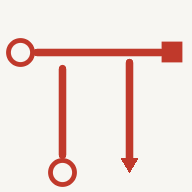
Two Gratings, Misaligned. A Phantom Edge Runs Between Them.
Look — tap when ready
You are looking at the abutting-gratings illusion, a phenomenon first carefully studied by Ralph Hamstra-Bletz and later popularised in the 1970s and 1980s vision science literature. Two regions of parallel line segments sit side by side. In one region, the lines are oriented one way; in the other, they are rotated or offset. Along the border between the two regions, you see a sharp, clean edge · as if a piece of paper had been laid over the page and cut along that seam. No line is drawn along the border. The edge exists only because the texture changes.
What you are about to learn. What the abutting-gratings illusion actually is, why it is a texture-defined contour rather than a luminance-defined one, how it differs from Kanizsa and Ehrenstein in terms of the information it uses, which cortical areas build it, and why texture-defined edges have been a key tool in vision science for mapping the hierarchy of contour-processing areas.
What the Illusion Looks Like
Draw a square region filled with evenly-spaced parallel lines, all running vertically. Beside it, draw an identical square region, but with all the lines rotated 45 degrees. Where the two squares meet, the lines do not continue smoothly · their orientations differ abruptly.
Along the shared border, your visual system perceives a clean straight edge. The edge is as crisp as any ink-drawn line · but it is made purely from the texture discontinuity. Nothing has been added to the boundary itself.
The minimal recipe. Two adjacent texture fields whose local line orientations (or frequencies, or phases) differ significantly. The border between the fields is perceived as a sharp edge. The magnitude of the orientation difference matters · 45 degrees gives a very strong edge, 10 degrees gives a faint edge, 0 degrees (same orientation) gives no edge at all. Similar effects work with spatial frequency (thin vs. thick lines) and with texture element type (lines vs. dots).
Why It Works: Texture-Defined Contours
The abutting-gratings illusion is a demonstration of texture-defined contours · also called second-order contours, because they emerge from second-order statistics of the image (local texture properties) rather than from first-order luminance differences.
V1 neurons detect local orientation. Primary visual cortex has neurons tuned to specific line orientations. In the vertically-lined region, vertical-preferring neurons fire strongly. In the diagonally-lined region, diagonal-preferring neurons fire strongly.
Higher areas detect the boundary between orientation populations. Neurons in V2 and V4 receive input from populations of V1 neurons and can register when neighbouring populations are responding to different orientations. The boundary between the two populations becomes a second-order edge signal.
The cortex renders the edge. Once the texture boundary has been detected, your perceptual system renders it as a vivid contour · just as vivid as a first-order luminance edge. You see a sharp straight line between the two regions, even though no pixel along that line differs from any pixel adjacent to it.
Texture edges are not inferior to luminance edges. For a long time, vision scientists assumed that the visual system relied primarily on first-order luminance edges. The discovery that texture-defined edges are processed by their own dedicated machinery · and produce equally vivid perceptions · forced a rethinking. Your visual system runs two largely parallel streams for edge detection: one for luminance, one for texture. Both are fully featured. Both feed into the same scene-parsing downstream.
Beyond Orientation: Other Texture Cues
Abutting gratings exploit orientation, but any texture property that differs across a boundary can produce an illusory edge.
The texture-cue family. Orientation differences: rotate one grating relative to the other. Spatial frequency differences: thin lines next to thick lines. Density differences: sparse dots next to dense dots. Phase differences: otherwise-identical gratings offset by a half-cycle. Motion direction differences: rightward-moving dots next to leftward-moving dots (dynamic abutting). All of these produce texture-defined edges. The visual system has multiple feature dimensions along which it can detect boundaries, and a boundary on any of them is enough.
The Neural Pathway
The abutting-gratings illusion has been mapped carefully with electrophysiology and fMRI.
The second-order pathway. V1 neurons respond only to the first-order luminance features (individual lines). V2 neurons begin to respond to texture boundaries · some V2 cells fire when a texture discontinuity passes through their receptive field, regardless of whether a luminance edge is present. V4 and LOC (lateral occipital complex) show even stronger responses to texture-defined contours. So the illusory edge is built in a hierarchy: V1 sees lines, V2 and beyond see the boundary between line populations.
A Harder Variant
Below is an abutting-gratings figure at difficulty 3 · finer lines and more aggressive orientation differences. The edge between the two regions is vivid, even though no ink defines it.
Look — tap when ready
Common misconception: “this is just the same as a Kanizsa edge.” It is not. Kanizsa edges are built from inducer geometry · specific corner-like features at specific locations. Abutting-gratings edges are built from texture statistics · populations of neurons responding to differently-oriented features across large regions. The cortical machinery is different. Kanizsa lives in V2 shape-completion circuits; abutting gratings lives in the texture-segmentation pathway. They are two separate ways of building contours, both of which are present in your visual system.
The Classical Vision Science Role
Abutting gratings have been one of the most important stimuli in mapping the cortical visual hierarchy.
Lesion and imaging evidence. Patients with lesions in V2 and surrounding areas often lose the ability to perceive texture-defined edges while retaining perception of luminance-defined edges. This dissociation was key evidence that edge detection is not a single process but a multi-pathway one. Conversely, some patients with V1 lesions lose first-order edge perception but retain (via the colliculus and pulvinar) a residual ability to detect texture boundaries. These clinical cases map cleanly onto the two-pathway account.
Where Abutting Gratings Appear in the World
- Natural camouflage and camouflage-breaking. An animal’s patterned fur or skin works as camouflage when the texture matches the background. An abutting-gratings mechanism in your visual system still often detects the animal because the statistical pattern of its texture differs slightly from the background · orientation, density, or scale. This is why experienced birdwatchers can spot well-camouflaged birds that novices miss.
- Fabric and textile boundaries. Two panels of a garment with the same colour but slightly different weave directions will show a visible seam · because of texture-defined edge detection, not luminance. Tailors exploit this for subtle design accents.
- Aerial photography and remote sensing. Field boundaries in agricultural images are often invisible in ordinary luminance processing (both fields are green) but appear clearly because of texture differences (different crops have different textures at the pixel level). Automated image segmentation algorithms for satellite imagery make heavy use of texture-boundary detection.
- Medical imaging. Ultrasound and MRI images reveal tissue boundaries by texture differences. The visual system’s ability to pick out those boundaries is what makes human radiological interpretation possible.
- Font design. Letterforms with subtle texture variations (fine hairlines, serifs of different orientations) recruit texture-boundary circuits in ways that affect legibility. Font designers who understand the second-order pathway make more readable typefaces at small sizes.
Test Yourself on 50 More Illusions
The abutting-gratings illusion is one of more than 50 classical illusions on PlayMemorize. Each round draws a deterministic SVG scene and asks one grounded question: which is larger, which is brighter, which is actually parallel. The reveal overlay shows the true geometry plus a one-line “why it works” caption.
- Keep playing Abutting Gratings → · the standalone game, pinned to this one figure with fresh seeds each round
- Play Illusions → · spot the tricks across size, colour, orientation, and impossible figures
- Play Spatial → · train mental rotation and area estimation
- Play Matrix → · abstract pattern reasoning under time pressure
The takeaway. The abutting-gratings illusion is proof that your visual system detects edges along more than one channel. First-order luminance edges matter · but so do second-order texture edges, built from population-level statistics of orientation, frequency, density, and motion. The cortex runs both streams in parallel and fuses them into a unified scene. The abutting-gratings figure makes the second stream visible in isolation: a crisp edge with no ink behind it, generated entirely by the texture discontinuity. Your visual cortex does not need ink to draw an edge. It only needs a reason to put one there.
Illusions
Your eyes lie - the math knows the truth. Spot equal lengths, identical greys, and truly parallel lines across 57 classic optical illusions
立即开始 - 完全免费无需账户,适用于任何设备。