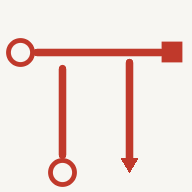
Two Identical Curves. The Bottom One Looks Bigger.
Which line/shape is bigger?
You are looking at the Jastrow illusion, published by the American psychologist Joseph Jastrow in 1889 · the same year Müller-Lyer dropped his arrows on the world. Two curved arcs are stacked vertically, with the lower arc shifted slightly so its short inner edge sits directly beneath the upper arc’s long outer edge. The lower arc looks noticeably larger. The two arcs are pixel-for-pixel identical · generated by the same code the standalone Illusions game uses, so the equality is not a claim, it is a computed property of the figure.
What you are about to learn. What the Jastrow illusion actually is, why the shift-and-stack geometry does the work, two competing theories for the perceptual distortion, a family of commercial knock-offs you have probably played with, and the finger-cover test that collapses the illusion in an instant.
What the Illusion Looks Like
Take two identical wedge-shaped arcs, like the curved corner cut off a pie. Stack them so one sits directly below the other, but slide the lower arc a little to the right so its short edge (the inner curve) lines up beneath the long edge (the outer curve) of the arc above it.
The lower arc appears longer · sometimes substantially, sometimes subtly, depending on how aggressively you line up the edges. Swap them (move the shorter-looking arc into the lower slot) and the illusion flips: whichever arc is on the bottom looks bigger.
The minimal recipe. Two curved shapes whose longer and shorter edges sit adjacent to each other, close enough for direct comparison. The alignment is what does the work · if you stack the arcs flush or pull them apart, the illusion weakens dramatically.
The Two Theories
Jastrow himself proposed a contrast-based account, and a second theory emerged later to address cases his original explanation struggled with.
Edge-length contrast. Your visual system compares adjacent edges rather than entire shapes. Where the lower arc’s short inner edge sits directly under the upper arc’s long outer edge, the two edges get compared side by side. The short edge looks shorter by contrast, and the long edge looks longer. Since you are reading the long edge as “the length of the lower arc” and the short edge as “the length of the upper arc”, the comparison makes the lower arc appear larger.
Global-shape assimilation. A more recent account argues that you do not just compare edges · you compare whole contours. The outer curve of each arc is substantially longer than the inner curve. When the inner curve of the lower arc abuts the outer curve of the upper arc, your visual system implicitly “grows” the lower arc to match the outer curve’s length, and “shrinks” the upper arc to match the inner curve’s length. The effect is akin to the Ebbinghaus: context pulls each shape’s perceived size toward its neighbour.
These theories are not mutually exclusive. Jastrow’s original edge-contrast account probably explains the effect at the local level; the shape-assimilation theory explains why the illusion survives even when the adjacent edges are obscured by small gaps. Real perception tends to stack both mechanisms.
The Cover Test
Here is the single clearest demonstration that nothing about the arcs themselves is different.
Cover the abutting edges with a fingertip. Place a finger or a strip of paper over the region where the short edge of one arc meets the long edge of the other. The size difference collapses instantly. Lift the cover and the lower arc swells again. This is direct proof that the illusion lives in the edge-adjacency, not in the arcs.
The Commercial Knock-Offs
If you grew up in North America or Europe you have almost certainly played with a physical Jastrow illusion without realising. The classic “boomerang toy” (sometimes sold as “Jastrow’s twins” or “the magical curves”) is a pair of identical banana-shaped pieces of wood or plastic.
- Lay them side by side, close together · one looks larger.
- Swap their positions · the other one now looks larger.
- Hand them to a friend · they will swear you have replaced the pieces.
The toy has been produced commercially since at least the 1920s under various names. Vintage versions turn up in flea markets; modern 3D-printed versions are cheap and easy to make. Magicians have used the shape for close-up routines that exploit the illusion’s reliability · it works on essentially every viewer, and knowing the trick does not dispel it.
Make your own in five minutes. Cut two identical banana-curves from stiff cardboard using the same template. Lay one directly above the other, then slide the lower one slightly to the right so its inner edge sits below the upper one’s outer edge. You now have a pocket Jastrow. Swap the two pieces and your friends will swear you have secretly replaced one of them.
Why Knowing Does Not Cure It
Like the Müller-Lyer and Ebbinghaus, the Jastrow survives full knowledge of the trick. You can measure the pieces with a ruler, confirm they are identical, and still see a size difference when you look again.
Common misconception: “If I focus on the short edges, the illusion will go away.” It will not. The comparison is automatic. Fixating on the short edges just changes which edge gets flagged as short · the scaling of the whole arc happens downstream of attention. The only reliable way to turn the illusion off is to cover the adjacent edges or physically separate the arcs.
A Harder Variant
At lower difficulty the arcs sit farther apart and the edge contrast is gentler. Below is a harder variant, difficulty 3, where the arcs are closer and the mismatch is sharper. The illusion punches harder but the underlying geometry is exactly the same · same arc lengths, same thickness, same offset ratio.
Which line/shape is bigger?
The difficulty knob maps to edge contrast. In the PlayMemorize generator, the Jastrow’s arcLen, arcThick, and offset parameters all interpolate with subtlety: easier rounds have bigger arcs, thicker bodies, and larger offsets, so the edge comparison is more aggressive. Harder rounds shrink everything but keep the geometric relationships identical.
Where the Jastrow Hides in Plain Sight
The Jastrow is a specialty illusion · it does not show up in architecture or photography the way Ponzo or Müller-Lyer do. But there are pockets where it matters:
- Packaging design. Stacking two curved products (two slices of pie, two pastry pieces, two banana-shaped chocolates) with one shifted relative to the other will reliably make one look larger. Confectioners know this; it is one reason boxed sweets tend to be aligned rather than staggered.
- Information design. Adjacent curved chart segments (pie-chart slices, radial bar charts) of equal size can look unequal if their bounding edges line up poorly. Tools like D3 and matplotlib have options to add explicit gaps for exactly this reason.
- Typography. Certain italic glyphs with curved terminals (look at lowercase
c,e,s) placed adjacent to their serifed counterparts on a page can inherit a mild Jastrow effect · one looks wider than its identical neighbour.
Test Yourself on 50 More Illusions
The Jastrow is one of more than 50 classical illusions on PlayMemorize. Each round draws a deterministic SVG scene and asks one grounded question: which is larger, which is brighter, which is actually parallel. The reveal overlay shows the true geometry plus a one-line “why it works” caption.
- Keep playing Jastrow → · the standalone game, pinned to this one figure with fresh seeds each round
- Play Illusions → · spot the tricks across size, colour, orientation, and impossible figures
- Play Spatial → · train mental rotation and area estimation
- Play Matrix → · abstract pattern reasoning under time pressure
The takeaway. The Jastrow is one of the purest demonstrations that your visual system compares edges, not objects. Two shapes that are geometrically identical do not feel identical if their edges are forced into local comparison. Covering the abutting edges is the trick that shuts the illusion off · which in turn is the clearest possible evidence that the illusion is a local computation, not a global one.
Illusions
Your eyes lie - the math knows the truth. Spot equal lengths, identical greys, and truly parallel lines across 57 classic optical illusions
Play now - it's freeNo account needed. Works on any device.